
Summary
First, secure admission from an SEVP-certified U.S. school. Then receive Form I-20 and pay the SEVIS fee. Complete DS-160, book your interview, and attend the VAC step in India. Carry clear academic, financial, and travel documents. Strong preparation can reduce avoidable delays. For guidance in Thane, UMA Educational Services can help you plan each step with confidence.
Introduction
According to the U.S. Department of State, you must first be accepted by a U.S. school before applying for an F-1 visa. The school then issues Form I-20 after entering your details in SEVIS. That I-20 is central to the whole application.
For many families, the hardest part is not the form. It is knowing what comes first. Admission, I-20, SEVIS, DS-160, and interview steps must follow the right order. That is why the F-1 student visa process for Indian students should be planned early and carefully.
This guide explains each stage simply. You will learn the documents, the interview flow, and common mistakes. You will also see how UMA Educational Services supports students who want clear guidance from Thane. The F-1 student visa process for Indian students becomes easier when every step is understood before you start.
What documents should you prepare before applying?
Start with the essentials. Your documents prove admission, identity, finances, and study intent. The U.S. system expects clear records before the visa interview.
| Document | Why it matters |
| Form I-20 | Shows school admission and programme details |
| Passport | Confirms identity and travel eligibility |
| DS-160 confirmation | Proves your online visa application is submitted |
| SEVIS fee receipt | Shows SEVIS payment linked to your record |
| Financial proof | Supports your ability to fund study |
| Academic records | Shows your study history and eligibility |
| Photo | Needed for the online visa form and interview process |
The U.S. Embassy in New Delhi also requires appointment registration and fingerprint submission at the VAC before the interview. Keep your documents neat and consistent. Small errors can create bigger delays later.
How do DS-160, SEVIS, and I-20 fit together?
Think of these as three connected steps. Your school first issues the I-20. That I-20 links your student record to SEVIS. Then you complete DS-160 for the visa application.
SEVIS is not optional. All F-1 students must be registered in it. Your visa type must also match your Form I-20. That matching step matters.
After DS-160 submission, you must confirm interview scheduling with the embassy or consulate. That step is part of the normal nonimmigrant visa flow. So, do not treat DS-160 as the final stage. It is only one part of the process.
What happens at the embassy interview in India?
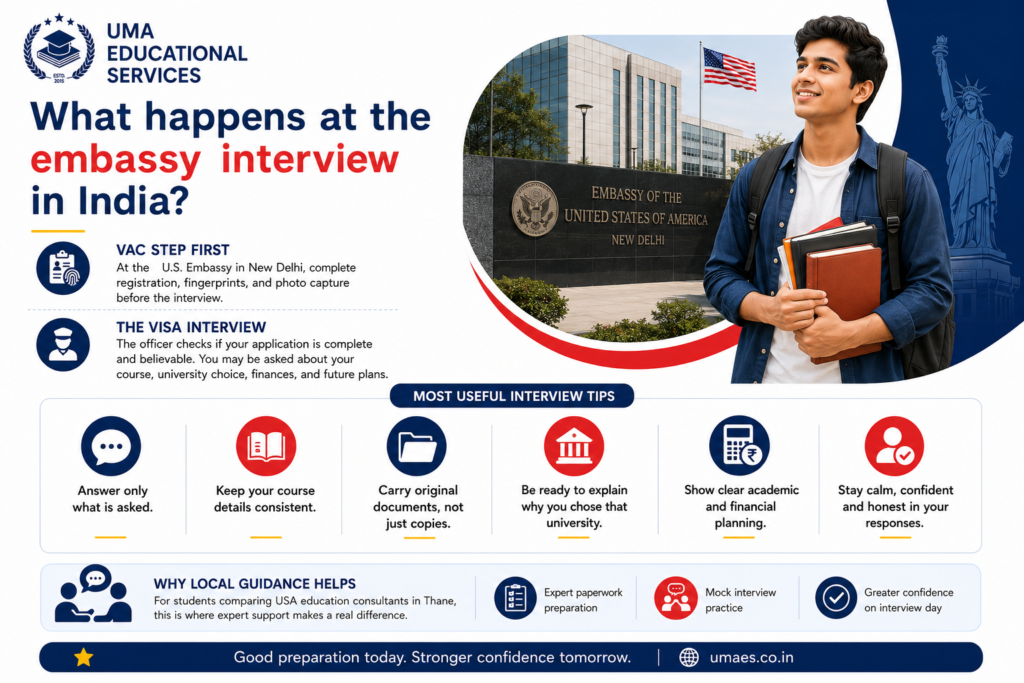
In India, applicants usually complete the VAC step first. At the U.S. Embassy in New Delhi, that includes registration, fingerprints, and photo capture before the interview. After that, you attend the visa interview with your documents.
The officer checks whether your application is complete and believable. They may ask about your course, university choice, finances, and future plans. A calm, clear answer is often better than a long one.
Here are the most useful interview tips.
- Answer only what is asked.
- Keep your course details consistent.
- Carry original documents, not just copies.
- Be ready to explain why you chose that university.
- Show clear academic and financial planning.
For students comparing USA education consultants in Thane, this is where local guidance helps most. A good counsellor can prepare your paperwork and mock interview practice. That support can reduce confusion before you face the officer.
Why do some applications get delayed or refused?
Refusals often happen when information is incomplete. They can also happen when the officer is not satisfied with eligibility. Missing details, weak documents, or unclear intent can all create problems.
Another common issue is poor preparation. Students sometimes submit inconsistent financial proof. Others cannot explain their academic choice clearly. Some do not understand the difference between admission and visa approval.
Avoid these mistakes.
- Submitting a mismatched I-20 and visa plan
- Giving vague answers in the interview
- Ignoring embassy instructions
- Leaving financial documents incomplete
- Waiting too long to begin the process
A clean application tells a better story. It shows seriousness, planning, and intent. That is especially important for the F-1 student visa process for Indian students, where every detail must support your case.
How can usa education consultants in thane help?
Right guidance saves time. It also reduces avoidable visa mistakes. That is why many families look for us education consultants in Thane before starting applications.
UMA Educational Services can help with course selection, document review, and interview readiness. It can also help you understand university timelines. That matters because admission and visa planning must move together.
A local consultant is useful when you need face-to-face clarity. You can ask questions, review paperwork, and check next steps quickly. For students and parents, that support brings confidence. It also keeps the process organised from the beginning.
Why choose overseas education consultants thane for a smoother plan?
Overseas education consultants thane can simplify a process that feels technical. They help you compare universities, read admission requirements, and prepare the visa file. They can also help you avoid rushed decisions.
A good consultant looks at the full picture. That includes course fit, finances, visa timing, and long-term goals. They do not just fill forms. They help you build a stronger application path.
This is especially useful for first-time applicants. Many students know the university they want. They do not always know the sequence after admission. That is where support becomes valuable.
Frequently asked questions
What is the first step in the visa process?
You must first get admission to a U.S. school and receive Form I-20. That document starts the student visa process and links your record to SEVIS.
Do I need DS-160 before the interview?
Yes. DS-160 is the online nonimmigrant visa application. You submit it before scheduling and attending the visa interview.
Is the VAC step required in India?
Yes, for applicants in New Delhi’s process flow, registration and fingerprint submission at the VAC come before the interview. Always follow the instructions for your embassy location.
Why is the I-20 so important?
The I-20 proves your school admission and programme details. Your visa type must match it, and it is required for the student visa process.
Can consultants help with the interview?
Yes. They can help you organise documents, practise answers, and understand the process. That support is useful for first-time applicants in Thane.
Conclusion
The visa journey becomes simpler when you follow the right order. Start with admission. Then handle I-20, SEVIS, DS-160, and interview preparation with care.
Strong documents and clear answers matter most. So does timing. With the right support, the F-1 student visa process for Indian students feels far less stressful.
If you want step-by-step help from a trusted study abroad consultant in Thane, UMA Educational Services is ready to guide you.