
Summary
German A2 level builds basic everyday communication. You learn to talk about routine life, needs, and simple plans. Most learners complete it after A1, with steady practice. A2 certification shows you can handle simple, familiar situations. It is useful for study, work, and relocation goals. UMA Educational Services can help you choose the right learning path.
Introduction
According to the Goethe-Institut and other language schools, A2 sits just above beginner level and helps learners manage simple, routine conversations. That matters when you need more than textbook German. It matters for travel, study, and daily life.
Many students start with confidence. Then they feel stuck at the first real conversation. They know grammar. They still struggle to speak naturally. That gap can feel frustrating.
This guide explains what the German A2 level includes, how long it usually takes, and what certification means. It also helps you understand whether the German A2 level is the right next step for your goal. If you are planning German language study through UMA Educational Services, this will make your decision easier.
What do you learn at German A2 level?
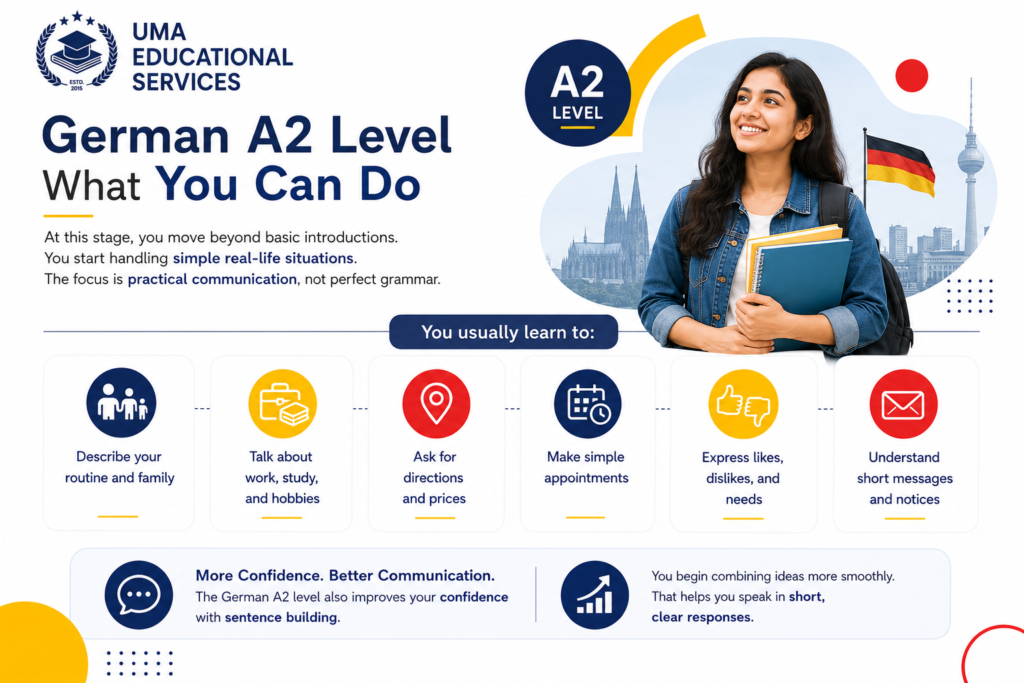
At this stage, you move beyond basic introductions. You start handling simple real-life situations. The focus is practical communication, not perfect grammar.
You usually learn to:
- Describe your routine and family
- Talk about work, study, and hobbies
- Ask for directions and prices
- Make simple appointments
- Express likes, dislikes, and needs
- Understand short messages and notices
The German A2 level also improves your confidence with sentence building. You begin combining ideas more smoothly. That helps you speak in short, clear responses.
What skills grow the most at this stage?
You gain more control over everyday language. Listening improves because you hear familiar words more often. Reading becomes easier with short notices, emails, and simple texts. Speaking becomes less mechanical. Writing becomes more useful for basic communication.
| Skill area | What you can usually do |
| Listening | Understand short, clear speech |
| Speaking | Answer simple questions and share basic details |
| Reading | Follow notices, signs, and short messages |
| Writing | Fill forms and write short notes |
| Grammar | Use common tenses and everyday sentence patterns |
This stage is important for students who want structured progress. It bridges the gap between survival German and useful daily German. If you plan to study in Germany later, this level can support your journey.
How long does German A2 level usually take?
The duration depends on your learning speed, class frequency, and practice time. Most learners need a few months after A1. Some finish faster with daily exposure and strong revision.
A regular batch may move at a comfortable pace. An intensive batch may finish sooner.
Self-study can help, but only if it stays consistent. Without practice, the level feels harder than it is.
| Learning format | Approximate pace | Best for |
| Regular class | Slower, steady progress | Working students |
| Intensive class | Faster completion | Students with more time |
| Self-study support | Flexible pace | Independent learners |
| Mixed learning | Balanced pace | Most beginners |
The German A2 level is not about speed alone. It is about retention. You should be able to use what you learn, not just pass a lesson. That is why revision matters so much.
If you are preparing with UMA Educational Services, ask for a plan that matches your timeline. A realistic schedule always works better than a rushed one.
What does German A2 certification prove?
An A2 certificate shows that you can handle simple, familiar communication. It proves you are beyond the beginner stage. That can matter for personal, academic, or migration-related goals.
The German A2 level certificate is often useful when:
- You want to show basic language progress
- You need proof for a course application
- You want to strengthen your profile
- You plan a longer German language journey
- You need confidence for daily life abroad
| Certification value | Why it helps |
| Academic profile | Shows language commitment |
| Migration planning | Supports basic communication proof |
| Career preparation | Adds value to your CV |
| Personal confidence | Validates real progress |
The certificate alone does not make you fluent. Still, it matters because it marks real ability. It also creates momentum for B1 and beyond.
For many learners, the German A2 level certificate is a motivation point. It tells you that your study system is working. That can be very encouraging when progress feels slow.
How should you prepare for German A2 level?
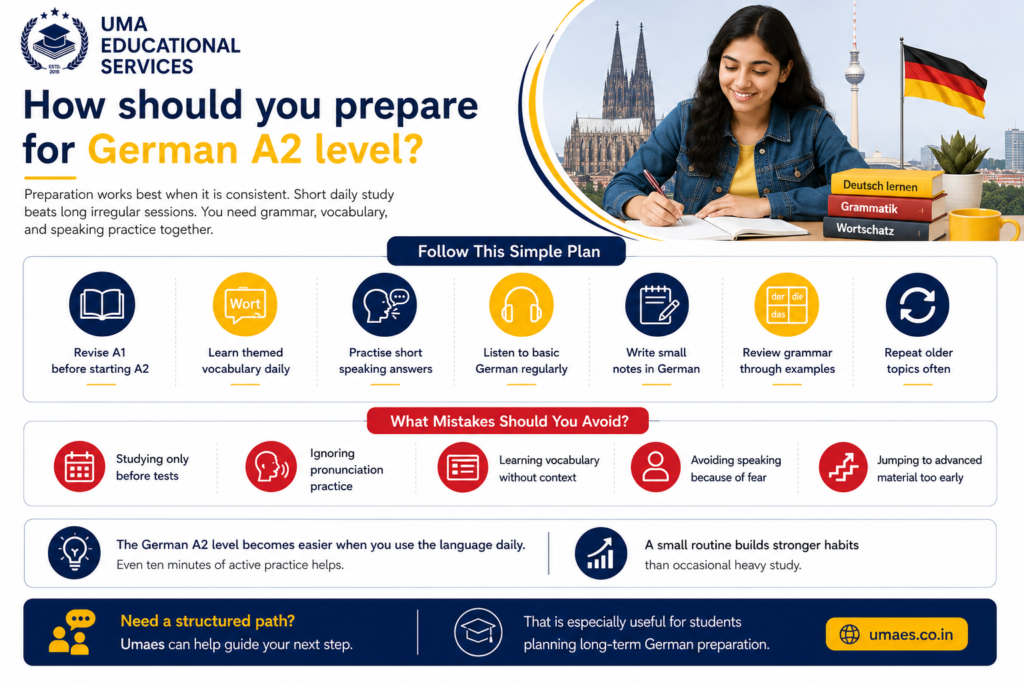
Preparation works best when it is consistent. Short daily study beats long irregular sessions. You need grammar, vocabulary, and speaking practice together.
Use this simple plan:
- Revise A1 before starting A2
- Learn themed vocabulary daily
- Practise short speaking answers
- Listen to basic German regularly
- Write small notes in German
- Review grammar through examples
- Repeat older topics often
What mistakes should you avoid?
Many learners focus only on grammar rules. That creates passive knowledge. They can recognise answers but cannot speak. Others skip revision and forget old material fast.
Avoid these common mistakes:
- Studying only before tests
- Ignoring pronunciation practice
- Learning vocabulary without context
- Avoiding speaking because of fear
- Jumping to advanced material too early
The German A2 level becomes easier when you use the language daily. Even ten minutes of active practice helps. A small routine builds stronger habits than occasional heavy study.
If you need a structured path, UMA Educational Services can help guide the next step. That is especially useful for students planning long-term German preparation.
Is German A2 level enough for study or work goals?
For many goals, A2 is a foundation, not the finish line. It can support basic communication and early profile building. But most advanced study or work goals need higher levels.
A2 is useful when you want to:
- Start language documentation
- Build confidence before B1
- Handle simple daily life tasks
- Prepare for a longer plan abroad
| Goal | Is A2 enough? | Notes |
| Basic communication | Yes | Good starting point |
| Daily survival language | Partly | Needs practice |
| Strong study preparation | No | Higher level needed later |
| Professional fluency | No | B2 or higher is usually needed |
So, think of German A2 level as a stepping stone. It helps you move ahead with structure. It also shows serious effort, which can matter in many student plans.
How can UMA Educational Services help you choose the right language path?
UMA Educational Services helps students make practical decisions. That includes course direction, language planning, and study abroad support. It is useful when you want a clear next step.
If you are in Thane, local support can make the process simpler. You can ask questions and get a path that suits your goal. That is helpful if you are unsure whether to continue to B1 or pause at A2 first.
The right plan depends on your destination, timeline, and budget. That is where guidance matters. A clear roadmap saves time and reduces confusion.
Frequently asked questions
What is German A2 level?
German A2 level is an elementary language stage. It helps you understand and use simple phrases, everyday expressions, and short conversations about familiar topics.
How long does German A2 level take?
It usually takes a few months after A1. The exact time depends on class frequency, practice, and how much time you spend revising.
Is German A2 level difficult?
It is manageable with regular study. The main challenge is remembering vocabulary and using grammar in real sentences, not just memorising rules.
What can I do after German A2 level?
You can move to B1, strengthen daily communication, and prepare for more advanced academic or work-related language needs.
Does German A2 certification help?
Yes. It shows verified progress and basic competence. That can support study plans, language goals, and future applications.
Conclusion
German language learning becomes easier when each stage has a purpose. A2 gives you more confidence, more control, and more practical communication.
It also creates a clear path for the next level.
If you are serious about long-term growth, the German A2 level is a strong step forward. It helps you build habits that last beyond the classroom.
It also prepares you for bigger goals later.
For students who want clear direction, UMA Educational Services can help you plan the journey with confidence. Talk to experts and move ahead with the right language strategy.