

Summary
Ireland offers a clear graduate route after studies. Level 8 graduates can usually stay 12 months. Level 9 and above graduates can usually stay 24 months. That time helps you search for work and move into an employment permit. For students planning to study in Ireland, the stay-back route is a major advantage. UMA Educational Services helps students in Thane plan that journey with clarity.
Why do Indian students care so much about stay-back options in Ireland?
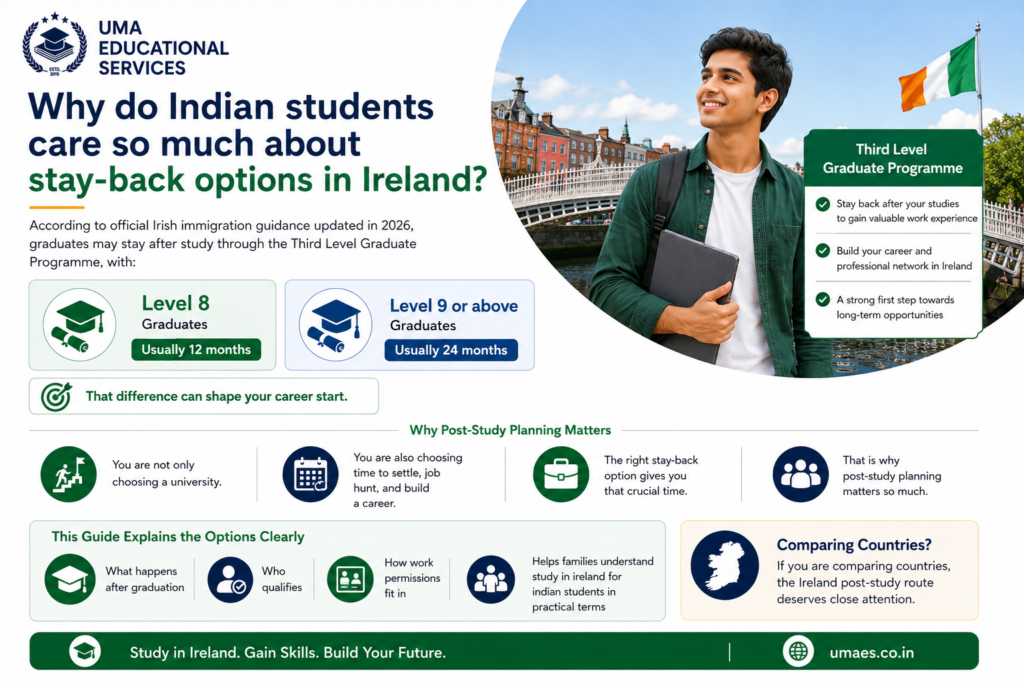
According to official Irish immigration guidance updated in 2026, graduates may stay after study through the Third Level Graduate Programme, with Level 8 graduates usually getting 12 months and Level 9 or above graduates usually getting 24 months. That difference can shape your career start.
For many students, the pressure starts before graduation. You are not only choosing a university. You are also choosing time to settle, job hunt, and build a career. That is why post-study planning matters so much.
This guide explains the options clearly. It shows what happens after graduation, who qualifies, and how work permissions fit in. It also helps families understand study in Ireland for Indian students in practical terms. If you are comparing countries, this route deserves close attention.
What stay-back permission can you get after graduation?
The main post-study route is the Third Level Graduate Programme. It is meant for legally resident non-EEA graduates from recognised Irish awarding bodies. The scheme lets graduates remain in Ireland to seek graduate-level employment.
| Qualification level | Usual stay-back period | Main purpose |
| Level 8 | 12 months | Job search and transition to work |
| Level 9 or above | 24 months | Longer job search and career planning |
This is the core choice most Indian students need to understand. If you complete an Irish degree at Level 8, your stay-back window is shorter. If you complete a master’s or higher award, you get more time.
That extra time can matter a lot. It gives you space to look for roles, improve your profile, and move into employment permission. So when you study in Ireland, the programme level should be chosen with your future job plan in mind.
How do you move from stay-back permission to a work visa?
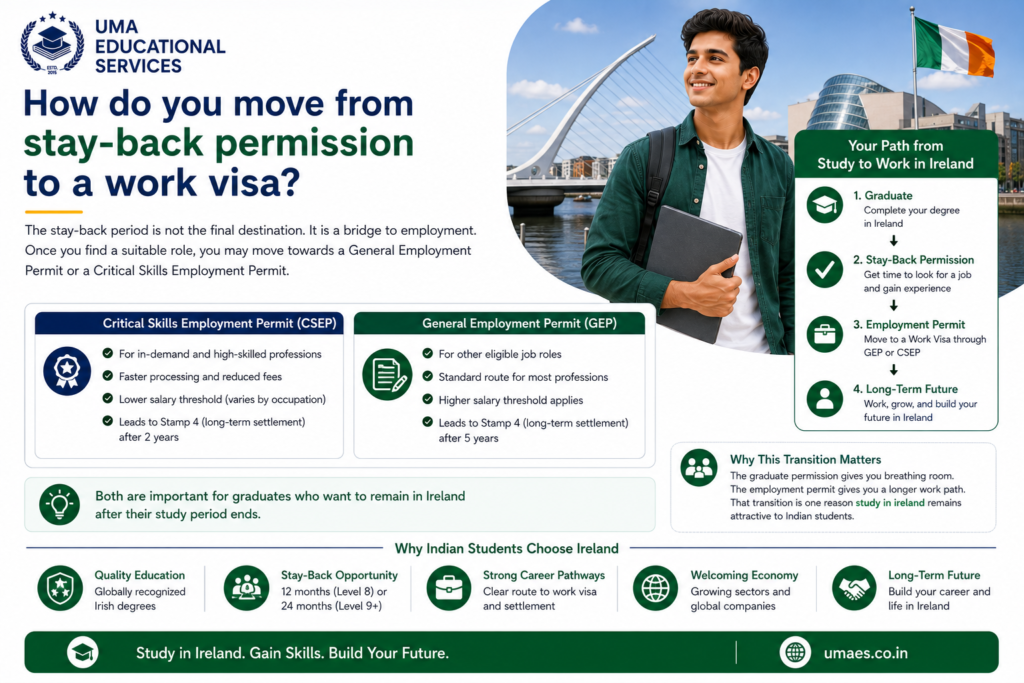
The stay-back period is not the final destination. It is a bridge to employment. Once you find a suitable role, you may move towards a General Employment Permit or a Critical Skills Employment Permit.
The Critical Skills route is designed for in-demand professions and aims to support long-term settlement. The General Employment Permit is the broader work route for other eligible jobs.
Both are important for graduates who want to remain in Ireland after their study period ends.
A simple way to think about it is this. The graduate permission gives you breathing room. The employment permit gives you a longer work path. That transition is one reason study in Ireland remains attractive to Indian students.
What should you prepare before your stay-back period starts?
Do not wait until your final semester.
Start planning early.
Your course choice, job target, and city preference all affect what happens next.
Use this checklist before graduation.
- Confirm your qualification level.
- Keep your immigration permission updated.
- Understand your next step after the graduate scheme.
- Track job roles that match your field.
- Prepare documents for employer screening.
- Stay aware of permit rules and timelines.
If you are exploring study in the Ireland through online searches, focus on the real process behind the phrase.
Admission is only the first step.
The stay-back plan should be ready before you land.
That approach saves stress later.
Which post-study path suits different career goals?
Not every student needs the same route.
Your best option depends on your level, subject, and job market goal.
Use this quick comparison.
| Goal | Best-fit route | Why it works |
| Fast job search after bachelor’s | Level 8 graduate permission | Gives 12 months to find work |
| More time for career planning | Level 9 or above graduate permission | Gives 24 months to search and settle |
| Long-term work in skilled roles | Critical Skills Employment Permit | Supports skilled career growth |
| Broader job options | General Employment Permit | Works for many eligible roles |
For Indian students, the best route is often the one that matches the degree level. A master’s can give more breathing room. A bachelor’s can still work well if your target role is clear.
That is why planning matters before you study in Ireland.
How can UMA Educational Services help students in Thane plan this better?
UMA Educational Services helps students and families make clearer decisions.
That is especially useful when the next step after graduation matters.
You may need course guidance, visa planning, or a work-path strategy.
If you live in Thane or nearby, local support can make the process easier.
You can compare options, ask direct questions, and align your study choice with your post-study goal.
That is useful for anyone deciding whether study in Ireland is the right fit.
UMA Educational Services can also help you see whether your course level supports your long-term plan.
That matters for students who want to study in Ireland for Indian students with a clear career outcome. The right advice early on can save time later.
Frequently asked questions
How long can Indian students stay in Ireland after graduation?
Level 8 graduates usually get 12 months. Level 9 or above graduates usually get 24 months. This is through the Third Level Graduate Programme.
Can I work during the stay-back period?
Yes. The graduate permission is meant to help you seek employment and move towards a relevant work permit. It is a bridge to your next stage.
What is the main difference between Level 8 and Level 9?
The main difference is duration. Level 8 usually gives 12 months, while Level 9 or above usually gives 24 months. That extra time can improve job search flexibility.
Is the graduate scheme only for non-EEA students?
Yes. The scheme is for legally resident Irish-educated non-EEA graduates who meet the qualification rules.
What comes after the stay-back permission ends?
You may move to a General Employment Permit or a Critical Skills Employment Permit if you secure an eligible role. That is the usual long-term route.
Conclusion
Ireland gives graduates a practical path after study. The stay-back period is built to help you find work and plan your next move. For Indian students, that can make a big difference.
The key is choosing the right qualification level. A Level 8 course gives one year. A Level 9 or higher course gives two. That is the heart of the post-study plan.
If you are comparing countries and want a realistic work pathway, the study in Ireland deserves serious attention. Talk to UMA Educational Services and build your plan with confidence.