
By the UMAES Team | 10 min read
Indian learners most often fail the German speaking module because they learned German on paper. They can read, write and pass a grammar test, but they have rarely spoken for three minutes without notes, or held a real exchange with a partner under a time limit. The oral exam tests exactly that. A German language course in Thane that builds speaking from the first week is the most reliable fix.
Key insights
- The oral exam tests interaction, not recitation: you are scored on how you respond to a partner, not just on what you prepared.
- Grammar-first learning produces readers: strong written scores and weak speaking scores are the most common Indian result pattern.
- Fluency counts alongside accuracy: long silences cost marks even when every sentence you finally say is correct.
- Speaking is a trained habit: weekly practice with correction beats any last-month cramming.
Before you go
Record yourself for three minutes today, talking in German about your weekend with no notes. Listen back once. Count the pauses longer than five seconds and the times you switched to English. Those two numbers tell you more about your oral exam readiness than any written mock test.
Every German teacher in India has seen the same result sheet. A learner scores well on reading, comfortably passes listening, does fine on writing, and then fails speaking. Sometimes the gap is dramatic. The learner knows the grammar better than half the class, and still cannot get through a fifteen-minute oral exam with a stranger and two examiners watching.
This piece explains why that happens. It covers what the oral exam at B1 and B2 actually asks you to do, how examiners score it, why Indian learners in particular struggle with it, and a practical speaking plan that closes the gap before exam day.
What does the German oral exam actually test?
The speaking module at B1 and B2 is not a vocabulary quiz or a grammar check. It tests whether you can use German to get something done with another person in real time.
The pair format
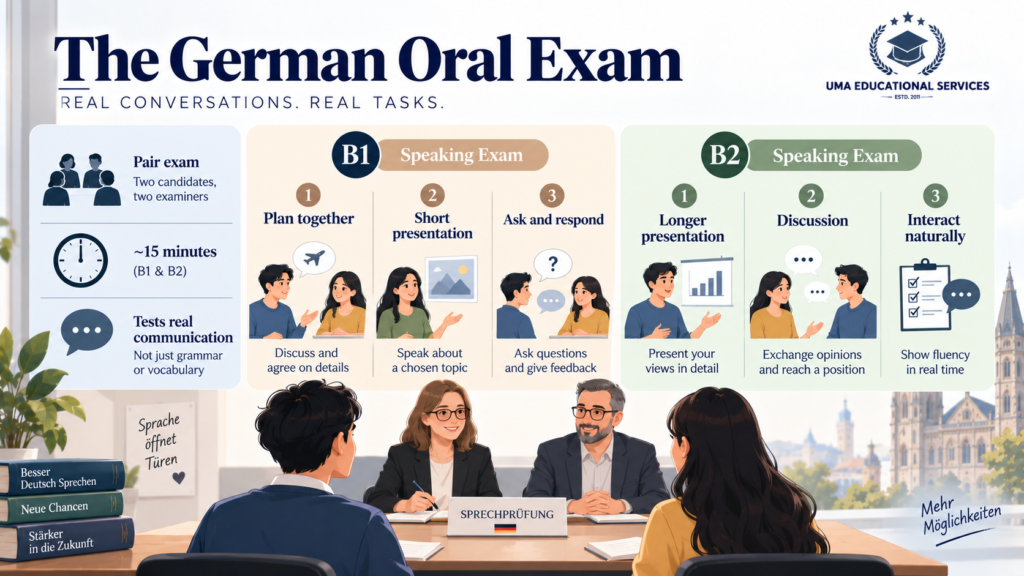
At the Goethe-Institut, the B1 speaking module is an oral pair exam conducted by two examiners, and the B2 speaking module follows the same pair structure. You are paired with another candidate, often someone you have never met, and part of your score depends on how you interact with them.
What happens in a B1 speaking exam
The Goethe B1 speaking exam runs for about 15 minutes and has three parts. First, you and your partner plan something together, such as a party or a trip, agreeing on details. Second, you each give a short presentation on a topic you chose from two options. Third, you ask each other a question about your presentations and respond to feedback.
What happens in a B2 speaking exam
The Goethe B2 speaking module also runs for about 15 minutes in pairs, with a longer individual presentation and a discussion in which the two candidates exchange views on a topic and try to reach a shared position. The discussion part is where many candidates struggle, because it cannot be prepared word for word.
| Level | Part 1 | Part 2 | Part 3 | Preparation time |
| B1 | Plan something together with your partner | Short presentation on a chosen topic | Question and answer about the presentations | About 15 minutes |
| B2 | Individual presentation on a topic | Questions from partner and examiner | Discussion to reach a shared position | About 15 minutes |
How do examiners score the speaking module?
Examiners score speaking against set criteria, and knowing them changes how you prepare.
The main scoring areas
Although wording varies by provider, speaking is usually judged on task completion, coherence and fluency, range of vocabulary, grammatical accuracy and pronunciation. Task completion and interaction usually carry as much weight as grammar.
What each criterion really means
- Task completion: did you do what the task asked, such as agreeing a plan, giving reasons or asking a question?
- Coherence and fluency: did your speech flow logically, with linking words and without long silences?
- Vocabulary range: did you use varied and appropriate words for the level?
- Accuracy: were your sentences grammatically correct enough to be understood without effort?
- Pronunciation: could the examiners understand you easily?
Why perfect grammar is not enough
A learner who speaks slowly, with long pauses, and produces only a few perfectly correct sentences, often scores lower than a learner who speaks steadily with small errors. Examiners are listening for a person who can communicate, not a person who can recite.
Why do Indian learners fail the German speaking exam?

The reasons are consistent enough that most teachers can predict them before the first mock test.
Grammar-first learning
Most Indian learners grew up learning languages through written grammar and translation. That method produces people who can read German comfortably and write it with care, but who have spoken it for only a few minutes a week. The exam then asks for fifteen minutes of spontaneous speech.
Large batches with little speaking time
In a class of twenty or thirty learners, each person may speak German for two or three minutes per session. Across a whole level, that adds up to very little real speaking practice, however many hours of class a learner attends.
Translating in the head
Many learners build every sentence in English or Hindi first, then translate it into German word by word. That process is slow, and German word order, with the verb at the end of subordinate clauses, makes it slower still. The pauses it creates are exactly what the fluency score punishes.
Fear of making mistakes
Learners who were taught to avoid errors at all costs often stay silent rather than risk a wrong ending. In the oral exam, silence is the most expensive mistake of all, because it scores nothing on any criterion.
Memorised answers that do not fit
Some learners memorise full presentations and model dialogues. When the partner says something unexpected, the memorised script breaks down, and the learner has no way to recover in real time.
| Why learners fail | What the examiner sees | What fixes it |
| Grammar-first learning | Slow, careful speech with long pauses | Weekly timed speaking practice |
| Too little speaking in class | Hesitation and short answers | Small batches or extra speaking sessions |
| Translating in the head | Word-by-word sentences, broken word order | Learning phrases as complete chunks |
| Fear of mistakes | Silence and one-word replies | Practice where errors are expected and corrected |
| Memorised scripts | Collapse when the partner goes off-script | Practising with changing partners and topics |
Why can a learner pass a written mock and still fail speaking?
Written and spoken German draw on the same knowledge, but they use it in very different ways.
Time to think
In reading and writing, you control the pace. You can reread a sentence, check an ending and fix a word order. In speaking, you have a second or two before the silence becomes noticeable, and your partner may interrupt before you finish.
Recognition versus retrieval
Reading and listening test whether you recognise German. Speaking tests whether you can retrieve it from memory quickly enough to use. A learner can recognise hundreds of words they cannot yet produce, which is why written scores often run well ahead of speaking scores.
Interaction adds pressure
In the pair format, you also have to listen to your partner, understand them and respond. That doubles the mental load compared with a written paper, and it is the part that classroom grammar practice never touches.
What speaking practice actually works?
Speaking improves through regular, timed, corrected practice, not through extra grammar lessons.
A weekly speaking routine
- Two minutes a day, recorded: talk about one everyday topic without notes and listen back once.
- One conversation a week: thirty minutes with a teacher, tutor or study partner, focused on real exchange.
- One exam task a week from B1: practise a planning task, a presentation or a discussion under exam timing.
- One correction review a week: note your three most frequent errors and practise those structures deliberately.
Learn phrases, not just words
Examiners reward learners who link ideas smoothly. Learn complete phrases for agreeing, disagreeing, suggesting, asking for clarification and summarising, such as “Das finde ich eine gute Idee, aber…” or “Könntest du das bitte noch einmal erklären?”. These chunks let you respond instantly instead of building every sentence from scratch.
| What you need to do | A phrase that works | When it earns marks |
| Suggest something | “Wie wäre es, wenn wir…?” | Planning tasks at B1 |
| Agree with a condition | “Einverstanden, aber wir sollten…” | Planning and discussion |
| Disagree politely | “Da bin ich anderer Meinung, weil…” | B2 discussion |
| Ask for clarification | “Wie meinst du das genau?” | Any interaction task |
| Buy thinking time | “Das ist eine gute Frage. Ich denke…” | Any moment you need a second |
| Summarise | “Wir haben uns also darauf geeinigt, dass…” | Closing a planning or discussion task |
Practise with different partners
Your exam partner will be a stranger with a different accent and level. Practising only with the same classmate builds false confidence. Rotate partners, and practise with people slightly above your level where possible.
Use the preparation time well
In the preparation time before the speaking exam, write keywords, not full sentences. A full written script tempts you to read aloud, which examiners notice and which sounds unnatural. Keywords keep you speaking in your own words.
How does speaking matter beyond the exam?
The oral exam is a checkpoint, but speaking is the skill that decides how life in Germany actually goes.
At a university or training company
Applicants for Ausbildung for Indian students are usually interviewed in German, often by phone or video. Training companies are looking for someone who can talk to customers and colleagues from the first week, so a B1 certificate with weak speaking often does not survive the interview. Good Ausbildung course consultants will push speaking practice for exactly this reason.
At work
Nurses, engineers and skilled workers all need spoken German daily, in handovers, meetings and phone calls. Employers often test speaking directly at interview, whatever the certificate says, and the guide on preparing for a nursing job interview in Germany shows how quickly the conversation moves beyond textbook German.
In daily life
Registering an address, talking to a landlord, visiting a doctor and making friends all happen in spoken German. Learners who can speak settle in faster, feel less isolated and progress much more quickly once they arrive.
How should you choose a German course that builds speaking?
The course you choose decides how many minutes you actually speak before the exam, which is the single strongest predictor of the speaking score.
Questions to ask before enrolling
- How many learners are in each batch: smaller batches mean more speaking time per person.
- How is speaking practised in each class: pair and group tasks every session are a good sign.
- Are there speaking mock tests: mock oral exams with feedback show you where marks are being lost.
- Is speaking corrected, or just encouraged: correction is what turns practice into improvement.
What good speaking training looks like
The best German language classes in Thane build speaking into every lesson from A1, rather than saving it for an exam batch at the end. Learners pair up, present, argue and plan in German weekly, so the exam format feels familiar well before exam day.
Wrapping up
The German speaking exam catches Indian learners because it tests the one skill that grammar-first learning skips: using German in real time with another person. The fix is not more grammar. It is regular, timed, corrected speaking practice from the first month, learning phrases as complete chunks, practising with different partners, and using mock oral exams to find where marks are lost. Pass the speaking module this way and you also leave with German you can actually use.
UMAES builds speaking into every level of its German training, with pair tasks and mock oral exams rather than grammar alone, so learners reach the exam already used to the format. The German language course sets out how speaking is taught at each level, and the team at the language preparation centre can arrange a speaking assessment before you choose a batch.
FAQs
Why is the German speaking exam so hard for Indian students?
Most Indian learners study German through grammar and writing, with little speaking practice. The oral exam needs spontaneous speech and real interaction with a partner, which grammar-focused learning does not build without regular timed practice.
How long is the Goethe B1 speaking exam?
About 15 minutes, taken in pairs with two examiners. It has three parts: planning something with your partner, a short individual presentation, and questions and feedback on each other’s presentations. Preparation time comes before the exam.
Can I retake only the speaking module of the Goethe exam?
Yes, from B1 upward Goethe exams are modular. You can retake only the speaking module if you passed the others, which saves time and fees compared with repeating the entire exam.
How can I improve my German speaking quickly?
Speak every day, even for two minutes, and record yourself. Add one weekly conversation with correction, learn useful phrases as chunks, and practise exam tasks under timing. Regular practice improves speaking faster than long occasional sessions.
Do grammar mistakes fail the German speaking exam?
No, small grammar mistakes rarely fail a candidate on their own. Examiners also score task completion, fluency, vocabulary and pronunciation. Long silences and incomplete tasks usually cost far more marks than minor errors.
Should I memorise answers for the German speaking exam?
No, not full answers. Memorised scripts break down when your partner or examiner says something unexpected. Learn useful phrases and prepare keywords for likely topics, then practise speaking freely in your own words.