

By the UMAES Team | 11 min read
For an Indian nurse moving to Germany, B2 German is the step that decides the timeline. Recognition of your nursing licence requires German at B2, and in many federal states a nursing-specific language exam as well. Your degree and experience are usually recognised on paper long before your German is ready, so German for nurses should be planned as the main project from day one, not squeezed in at the end.
Key insights
- Recognition waits for your German, not the other way round: most stalled nursing files are stalled on the language certificate.
- General B2 is not ward B2: a nurse needs handover, documentation and patient vocabulary that general classes rarely teach.
- Speaking is the risky module: nurses who study from textbooks pass reading and writing first and struggle with the oral.
- Start German before paperwork: documents take weeks, while B2 takes well over a year for most working nurses.
Before you go
Count backwards from the date you want to be working on a German ward. Take off at least four months for the recognition decision, then 15 to 20 months for B2 if you are still working. If that start date is already behind you, the German course needed to begin yesterday.
Every year, Indian nurses sign up for the Germany route with a clear picture of the paperwork and a vague picture of the language. Agents talk about apostilles, transcripts and recognition notices in detail, and mention B2 German in a single line, as if it were one more document to collect. It is not. It is the longest stage of the whole route and the one that most often holds a file back.
This piece explains why. It covers what the recognition authorities actually require, why files stall on language rather than qualifications, what the nursing exam tests that a general German course misses, the medical vocabulary problem, and how to run the language plan alongside the rest of the process.
Why does nursing recognition in Germany depend on B2 German?
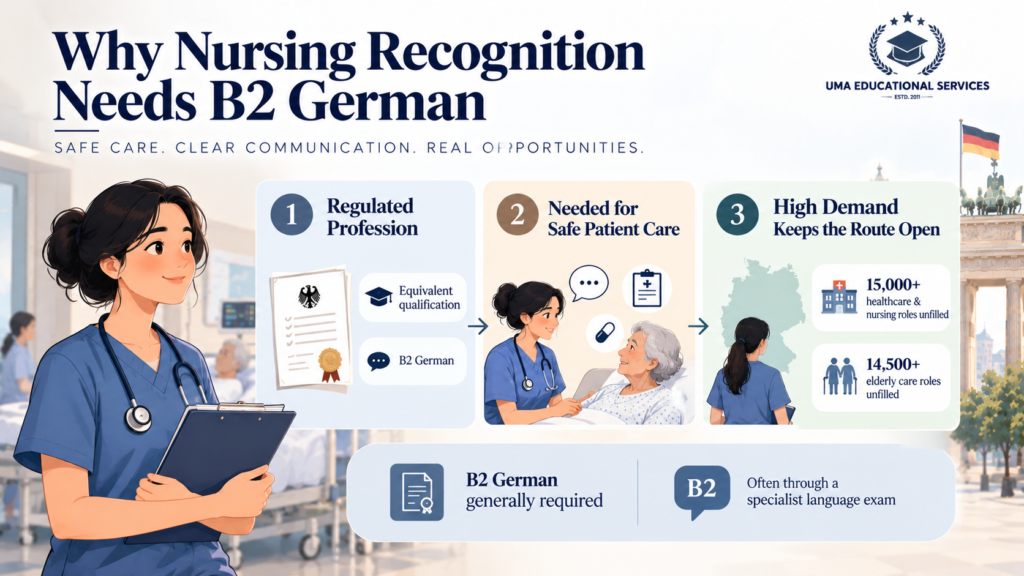
Nursing is a regulated profession in Germany. You cannot work under the title of a registered nurse until the state authority issues permission to use it, and that permission has two conditions: a qualification judged equivalent to German training, and sufficient German to work safely.
What the recognition portal says
Germany’s official recognition portal states that nurses generally need German at level B2 and may have to prove it through a specialist language examination. The exact certificate accepted depends on the federal state that handles your file, which is why two nurses from the same Indian college can receive slightly different instructions.
Why the language rule is strict
A nurse gives medication, takes verbal orders from doctors, explains procedures to frightened patients and writes records that other staff rely on. A misunderstanding in any of those moments is a patient safety problem. The B2 rule exists because hospitals and regulators want nurses who can follow and give instructions without guesswork.
Why the demand keeps the route open
Germany needs nurses badly. The Federal Employment Agency reported that more than 15,000 positions in healthcare and nursing, and another 14,500 in elderly care, could not be filled in 2024. That demand is why the recognition route exists, and also why employers will wait for a nurse’s German rather than lower the standard.
Why do nursing files stall on language rather than qualifications?
Most Indian nursing degrees are recognised with some conditions, and those conditions can be met. The language certificate is different, because it depends on hundreds of hours that no document can replace.
The paperwork moves in weeks
Transcripts, registration certificates, experience letters, apostilles and sworn translations take time, but it is predictable time. A well-organised nurse can assemble a complete file in two or three months.
The language moves in months
B2 needs roughly 450 to 600 hours of guided instruction from zero. A nurse working full shifts in an Indian hospital can usually manage six to eight hours of German a week, which puts B2 at 15 to 20 months away. That is the gap between a finished file and a finished route.
A typical nursing timeline, stage by stage
| Stage | What happens | Typical duration |
| German A1 to B1 | General German foundation | 9 to 14 months part time |
| Document collection | Degree, registration, experience, apostille, translation | 2 to 3 months, can run in parallel |
| Recognition application | File reviewed by the state authority | Up to 4 months after a complete file |
| German B1 to B2 | Professional and nursing language | 5 to 8 months part time |
| Adaptation or knowledge test | Closing any gaps the authority identifies | 3 to 12 months, often in Germany |
| Full recognition | Permission to use the nursing title | Follows the language and gap stages |
The German stages add up to more time than every other stage combined, which is the whole point of this article.
What does a nursing B2 exam test that general German classes miss?
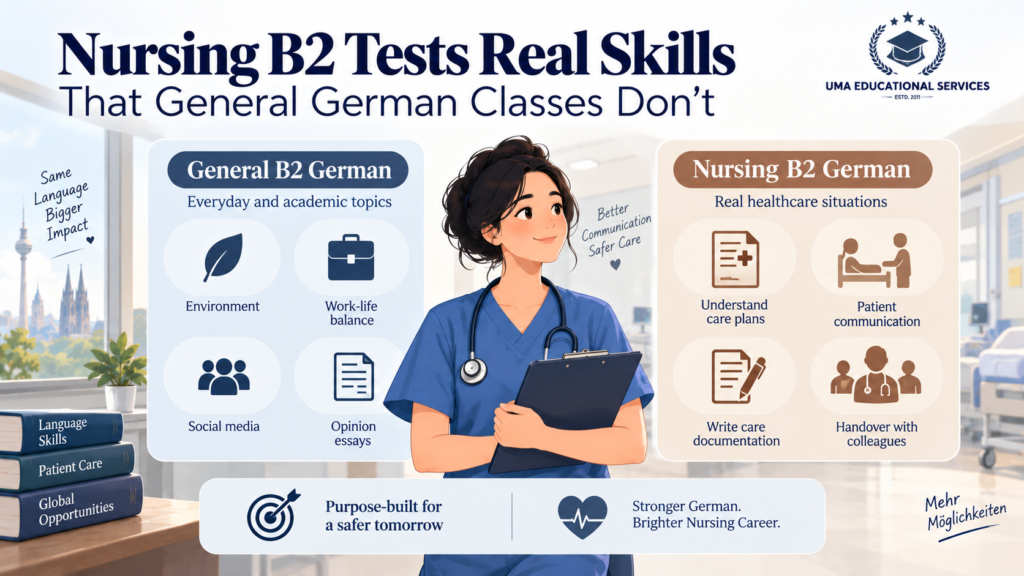
A general B2 course prepares you to discuss the environment, work-life balance and the pros and cons of social media. A nursing B2 exam, or the specialist language test some states require, asks you to do something else entirely.
Nursing-specific exam formats
The telc Deutsch B1-B2 Pflege was designed for exactly this purpose. It tests reading, listening, writing and speaking in nursing situations, such as understanding a care plan, following a handover or writing a short report. Some states accept a general B2 certificate, and others want this kind of profession-specific proof.
Written documentation
Nurses in Germany write care documentation every shift. The exam and the job both ask you to describe a patient’s condition, the care given and any changes, using the correct terms in clear sentences. General B2 writing tasks, which are usually opinion essays and formal emails, do not practise this.
Speaking with patients and colleagues
The oral tasks in nursing exams often simulate a patient conversation or a handover to a colleague. You may need to take a patient history, explain a procedure in simple words or report a change in condition to a doctor. That requires two registers at once: plain, reassuring German for the patient, and precise, technical German for the team.
| Skill | General B2 course practises | Nursing exam and ward require |
| Writing | Opinion essays, formal complaint emails | Care documentation, shift reports |
| Speaking | Discussing social topics, giving a view | Patient history, handover, explaining procedures |
| Listening | Radio interviews, lectures | Doctor’s instructions, patient complaints, handovers |
| Vocabulary | Society, environment, work | Anatomy, symptoms, medication, care routines |
Why is medical vocabulary such a problem for Indian nurses?
Indian nurses trained in English know the medical terms in English and often in Latin. German hospitals use both a formal medical vocabulary and an everyday one, and nurses need both.
Two words for everything
A doctor may say “Hypertonie” while the patient says “hoher Blutdruck”. The chart may say “Dyspnoe” while the patient says they cannot catch their breath. A German nurse moves between these constantly, and a nurse who only knows one set of words will miss half the conversation.
Patients speak in dialect and in fragments
Elderly patients, who make up a large share of hospital and care home residents, often speak regional dialects, speak quietly or struggle to find words themselves. Understanding them takes a trained ear that coursebook audio does not build.
How to close the gap
- Learn terms in pairs from B1 onwards: every medical term should be learned alongside its everyday equivalent.
- Practise handovers aloud: a two-minute structured handover in German, repeated daily, builds the most valuable single skill on the ward.
- Read real documentation: sample care plans and nursing reports teach the phrasing that German colleagues actually use.
- Listen to health content: German health podcasts and patient information videos train the ear for both registers.
Should you choose a general German course or German for nurses?
The answer is both, in sequence. A nursing-specific course without general foundations collapses, and a general course without nursing content leaves you unprepared for the ward.
A1 to B1: general German first
The first levels should be general. You need grammar, everyday vocabulary and basic conversation before specialist language makes any sense. Trying to learn medical German at A1 means memorising phrases without the grammar to use them.
B1 to B2: add the nursing layer
From B1, the course should add nursing scenarios, medical vocabulary and exam practice for the certificate your federal state accepts. This is where a general German language course in Thane and a nursing-focused plan need to join up.
Check the exam before you choose
Ask which certificate the authority handling your file accepts before you book an exam. A general Goethe B2 is widely accepted, but if your state requires a nursing-specific test, preparing for the wrong one costs months.
How should nurses compare Germany with other routes?
Germany is not the only destination for Indian nurses, and the language requirement is the biggest single difference between the options.
Germany versus English-speaking countries
Some nurses weigh Germany against Australia, the UK or New Zealand, where the language test is English, usually through IELTS or OET, rather than a new language. If you are also speaking with study abroad consultants for Australia in Thane, compare the full cost and timeline of each route, because a shorter language stage can come with a longer or more expensive registration process.
| Factor | Germany | English-speaking destinations |
| Language stage | B2 German, often 15 to 20 months part time | English test such as IELTS or OET, usually weeks to a few months |
| Recognition | State authority, with adaptation course or knowledge test if gaps exist | National or state nursing board, with its own assessment |
| Support while adapting | Adaptation programmes, often paid by the employer | Varies widely by country and employer |
| Long-term residence | Clear path to settlement once working | Depends on visa class and country |
Why many nurses still choose Germany
Germany offers free or low-cost adaptation programmes, strong demand, a clear path to permanent residence and a working language that opens other German-speaking countries as well. For nurses willing to invest in B2, the route is well-trodden and well-supported.
The honest question to ask yourself
Can you commit six to eight hours a week to German for well over a year while working? If yes, Germany is realistic. If not, it is better to know now and choose a route that fits, rather than start the German route and stall at B1.
What should an Indian nurse do first?
Start German and start the paperwork at the same time, but treat German as the stage that sets the date.
A practical order of operations
- Confirm the language rule for your target state: find out which certificate and level the authority accepts.
- Begin A1 immediately: every month of delay moves your start date by a month.
- Collect documents during A1 and A2: transcripts, registration and experience letters can be gathered while you study.
- Apply for recognition at B1 if your route allows it: some programmes let you file early and complete B2 during the adaptation period.
- Add nursing German from B1: switch the course focus to patient communication and documentation.
- Book the B2 exam with a buffer: leave time for a retake of any failed module before your planned start.
Choosing the right support
A good overseas education consultant in Thane should talk about your German plan before your paperwork, because the language is what sets the timeline. The nursing jobs abroad programme is built around that sequence, and if you are still wondering how much German the ward really demands, the guide on whether a nurse can work in Germany without speaking German answers it in detail.
Wrapping up
B2 German is not a box to tick at the end of the nursing route. It is the route. Recognition in Germany depends on it, many states want nursing-specific proof, and it takes longer than every other stage combined for a nurse who is still working. Start the language first, add nursing vocabulary from B1, confirm which exam your state accepts, and let the German timeline set the date you plan around.
UMAES runs German training and nursing placement support as one plan rather than two separate services, so the language stage and the recognition file move together. If you are a nurse considering Germany, the team at the language preparation centre can map your current level against your target start date and tell you honestly how long the route will take.
FAQs
Is B2 German mandatory for nurses in Germany?
Yes, B2 is generally required for full recognition as a nurse in Germany. Some federal states let nurses start in an adaptation role at B1, but B2 must be completed before the professional title is granted.
Which German exam should nurses take?
It depends on the federal state handling your recognition. Many accept the Goethe B2 or telc B2, while some require a nursing-specific test such as telc Deutsch B1-B2 Pflege. Confirm with the authority before booking any exam.
How long does it take a nurse to reach B2 German?
Usually 15 to 20 months for a nurse studying six to eight hours a week alongside work. Full-time intensive study can shorten this to around six to eight months, though speaking skills often need extra practice.
Can I start working in Germany as a nurse at B1?
Sometimes, yes. Certain recognition partnerships and adaptation programmes allow nurses to begin as nursing assistants at B1 while completing B2. Full nurse status and pay still depend on reaching B2 and completing recognition.
Do I need medical German for the nursing B2 exam?
Yes, for nursing-specific exams and for the job itself. Even where a general B2 is accepted, you will need medical and patient vocabulary on the ward, so it is worth building from B1 onwards.
Should I start German or the recognition paperwork first?
Start German first, then gather documents while you study. Paperwork takes two to three months, while B2 German takes well over a year part time, so the language is what sets your realistic start date.