

By the UMAES Team | 11 min read
Reaching B2 German from zero takes roughly 450 to 600 hours of guided instruction, plus a similar amount of self-study. At six to eight class hours a week, that works out to about 15 to 20 months. Six months is only realistic for someone studying full time, around 20 hours a week, with nothing else on their plate. Anyone comparing German language classes in Thane should start from those numbers.
Key insights
- B2 is a number of hours, not a number of months: the calendar only follows from how many hours you put in each week.
- Intensive study compresses grammar, not listening: the ear for fast speech builds with exposure over time.
- Six-month B2 is a full-time plan: it assumes the hours of a job spent in a classroom.
- Stalls cost more than slow weeks: a two-month break often means repeating a level.
Before you go
Before you compare any two German courses, ask each one the same question: how many class hours does this batch deliver per level? Divide your target level’s hours by that weekly figure. The answer is your real timeline, whatever the brochure says.
“How long does German take?” is the question almost every learner asks first. It is also the question most often answered with a number that suits the person selling the course. You will see “B2 in six months” on banners, in WhatsApp forwards and in adverts from coaching centres across Mumbai and Thane, usually aimed at nurses and students who are in a hurry.
This piece does the honest arithmetic instead. It covers how many hours each level needs, how weekly study hours turn into months, what genuinely speeds learning up, what no amount of intensity can compress, and the questions that expose an unrealistic promise before you pay for it.
How many hours does each German level take?
The most widely used estimate comes from the Goethe-Institut, which publishes cumulative guided-learning figures for each level. Its level guide puts B2 at 600 to 800 teaching units from a standing start, where one teaching unit is 45 minutes of instruction.
The Goethe estimates, converted to clock hours
| Level reached | Teaching units (45 min) | Approximate clock hours | What that means in practice |
| A1 | 80 to 200 | 60 to 150 | Introductions and simple transactions |
| A2 | 200 to 350 | 150 to 260 | Routine errands and simple conversations |
| B1 | 350 to 650 | 260 to 490 | Independent daily life and routine work |
| B2 | 600 to 800 | 450 to 600 | Professional conversations and technical topics |
| C1 | 800 to 1,000 | 600 to 750 | University study in German |
These figures are cumulative. B2 at 600 to 800 units means the total from your first lesson, not the extra hours after B1.
Why the ranges are so wide
The spread reflects real differences between learners. Someone who already speaks two or three languages, has studied a European language before, or lives with German speakers sits at the low end. Someone learning their first foreign language as an adult, with little listening practice outside class, sits at the high end.
A second benchmark that tells the same story
The US Foreign Service Institute trains diplomats full time and has decades of data on how long languages take. It places German in its second difficulty category and estimates around 36 weeks and 900 class hours to reach professional working proficiency for English speakers. Those are full-time students in small classes with homework every evening, and they still need most of a year.
How do study hours turn into months?
A timeline is simply total hours divided by weekly hours. Once you do that sum, the marketing claims either hold up or they do not.
The weekly-hours table
The table below uses 450 to 600 clock hours of instruction to reach B2, which is the Goethe range, and ignores self-study so that the comparison stays clean.
| Class hours per week | Typical format | Weeks to B2 | Months to B2 |
| 4 | Weekend-only batch | 112 to 150 | 26 to 35 |
| 6 to 8 | Weekday evening batch | 56 to 100 | 13 to 23 |
| 10 to 12 | Evening plus weekend | 38 to 60 | 9 to 14 |
| 20 to 25 | Full-time intensive | 18 to 30 | 4 to 7 |
What the table tells you
Six-month B2 appears in exactly one row, and that row describes a learner spending four to five hours in class every weekday. That is a job’s worth of time. It is achievable for a student between degrees, or for a nurse who has left work to prepare, but not for anyone keeping a full-time role.
The self-study multiplier
Classroom hours are only half the picture. Most teachers expect roughly one hour of self-study for every hour in class, covering vocabulary review, listening practice and homework. Learners who skip this land at the top of every range, and learners who do it consistently land near the bottom.
Why is “B2 in six months” usually a sales line?
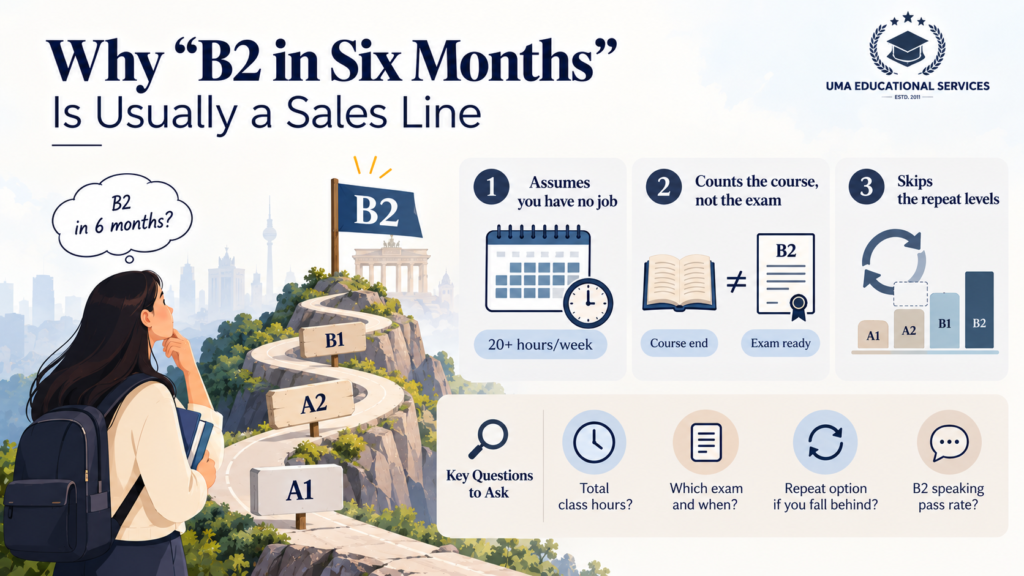
The claim is not always a lie, but it usually leaves out the conditions that make it true.
It assumes you have no job
A six-month B2 plan quietly assumes 20 or more class hours a week. When a working nurse or engineer enrols in a six-month course that meets for eight hours a week, the course cannot deliver B2, and the certificate at the end is often a lower level or no certificate at all.
It counts the course, not the exam
Some courses advertise the date the B2 syllabus ends, not the date you are ready to pass the B2 exam. Those are different moments. Finishing a coursebook is not the same as being able to speak for fifteen minutes with an examiner, and the gap between the two is often two or three months of exam practice.
It skips the repeat levels
Real timelines include repeats. Learners who miss classes, change shifts or fall ill often need to redo part of a level. A plan with no margin for that is a plan designed for the advert rather than for a real person.
Questions that expose an unrealistic promise
- How many class hours does the whole course contain: if the answer is well under 450, B2 is not the realistic outcome.
- Which exam, and when: a serious course names the certificate and has a mock test schedule.
- What happens if I fall behind: a good answer involves a repeat option, not a promise that it will not happen.
- What pass rate do your B2 students get on the speaking module: the speaking section is where rushed learners fail.
What can intensive study genuinely speed up?
Intensity does help, and it is worth being clear about where.
Grammar and structure compress well
German grammar is a finite system. Cases, verb positions and adjective endings can be learned faster with daily practice, because each lesson builds on the previous day while it is still fresh. Intensive batches often cover A1 to B1 grammar far faster than weekly classes can.
Vocabulary compresses partly
Daily exposure helps vocabulary stick, especially with spaced repetition. But vocabulary also needs time between reviews to move into long-term memory, so there is a ceiling on how much can be absorbed in a week, however many hours you study.
Exam technique compresses very well
Knowing the format of each exam section, the timing and the types of task is a short, learnable skill. A few weeks of focused exam training can lift a score noticeably, which is why many learners add a dedicated exam batch at the end.
| Skill | Compresses with intensity? | Why |
| Grammar | Yes, strongly | A closed system that builds day on day |
| Reading | Yes, fairly well | Improves quickly once grammar is in place |
| Vocabulary | Partly | Needs spaced time to move into long-term memory |
| Exam technique | Yes, strongly | A short, learnable set of formats |
| Listening at natural speed | Barely | Needs months of exposure to real speech |
| Spontaneous speaking | Barely | Grows from repeated practice over time |
What can no course compress?
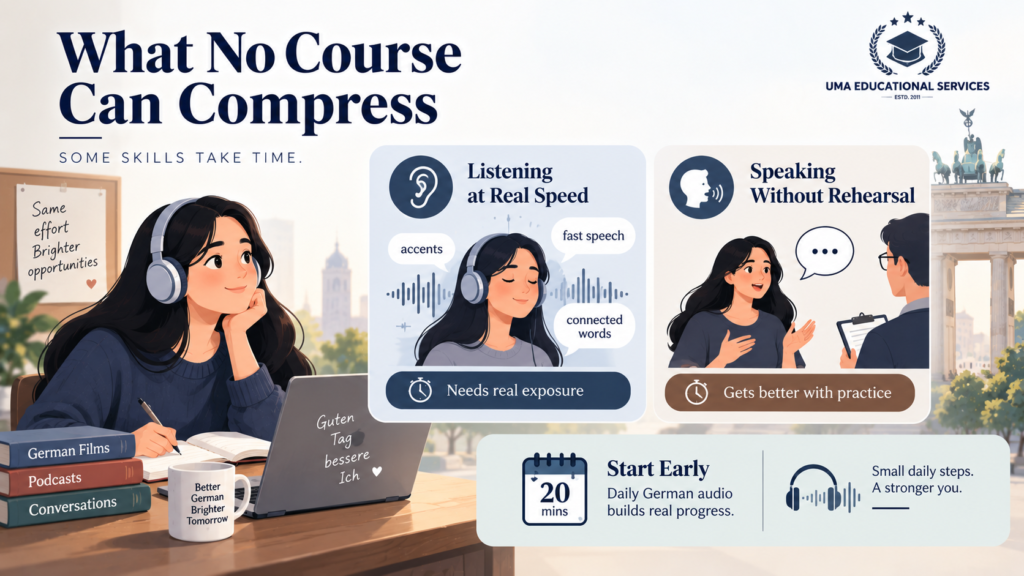
Two skills stubbornly refuse to be rushed, and they happen to be the two that decide whether you can function in Germany.
Listening at real speed
Native speakers do not talk like coursebook audio. They swallow endings, speak in regional accents and run words together. Your brain needs hundreds of hours of real German, from films, podcasts and conversation, before it can process speech at that pace. That exposure takes calendar time as well as study time.
Speaking without rehearsal
Speaking spontaneously means retrieving grammar and vocabulary in real time, under pressure. That retrieval gets faster only through repeated use. A learner who crams B2 grammar in four months may pass the reading paper and still freeze in the oral exam.
Why this matters for your plan
If your timeline is tight, spend your intensity on the parts that compress and start your listening and speaking habit from the first week. Twenty minutes of German audio every day for a year does more for your ear than a ten-hour weekend binge before the exam.
What else slows a German timeline down?
Most delays have nothing to do with ability. They come from the rest of a learner’s life.
Running two exams at once
Many students heading to Germany also need an English test for an English-taught programme, and some try to prepare for both in the same months. If you are also taking IELTS coaching in Thane or a similar course, plan the two so that their exam dates do not collide, because both need the same evenings.
Breaks between levels
A gap of two months between A2 and B1 often costs a month of revision when you return. Keeping the levels back to back, even at a lower weekly intensity, usually finishes sooner than a faster pace with long breaks in between.
Shift work and irregular schedules
Nurses, hospitality workers and anyone on rotating shifts miss classes more often. A course with recorded sessions or a flexible repeat policy protects the timeline far better than one that simply moves on.
No contact with German outside class
Learners who only meet German in the classroom progress more slowly than those who hear it daily. Free resources, German podcasts and a weekly conversation partner all shorten the path without adding class fees.
How do you build a realistic German timeline?
A realistic plan starts with your deadline and works backwards, rather than starting with a course and hoping it fits.
Step one: set the target level and date
Find the level your purpose requires and the date you need the certificate by. For a university application, that is the portal deadline. For nursing, it is usually the point your recognition file goes in.
Step two: count backwards in hours
Subtract a two-month buffer for exam booking, results and a possible retake. Divide the remaining weeks into the hours your target level needs. The result is the number of class hours per week you must commit to.
Step three: check that the weekly number is livable
If the weekly figure is higher than your life allows, move the date or change the target, not the promise. It is better to know now that you need 18 months than to discover it after the course fee has gone.
Why structured classes help
Self-study alone rarely holds a timeline for more than a few months. Good German language classes in Thane give you fixed hours, a teacher who corrects your speaking and a level test before each move up, which is what keeps a 15-month plan from quietly becoming a 24-month one.
Wrapping up
German takes the hours it takes. B2 needs roughly 450 to 600 hours of instruction plus self-study, and your calendar follows from how many of those hours fit into each week. Intensive study genuinely speeds up grammar, reading and exam technique, but listening and speaking still grow at their own pace. Plan from the hours, protect the timeline from breaks, and treat any six-month promise as a question to ask rather than a fact to accept.
UMAES builds German timelines from the target exam and the learner’s real week, whether that means a full-time intensive plan or an evening batch alongside a job. The German language course sets out the level structure, and the team can work through your target date with you before you commit to a format.
FAQs
How many hours does it take to reach B2 German?
Around 450 to 600 hours of guided instruction, according to Goethe-Institut estimates, plus roughly the same in self-study. The exact figure depends on your language background, your study routine and how much German you hear outside class.
Can I learn German to B2 in six months?
Yes, but only with full-time study of about 20 to 25 class hours a week plus self-study. For anyone working a full-time job, six months is not realistic, and 13 to 20 months is a more honest estimate.
How long does it take to go from A1 to B1 German?
Usually 9 to 16 months at six to eight class hours a week. B1 needs roughly 260 to 490 clock hours from zero, so full-time intensive learners can reach it in three to six months.
Is German harder to learn than French or Spanish?
German takes a little longer for most English speakers because of its case system and word order. The US Foreign Service Institute places it in a slightly harder category than French and Spanish, needing about 900 class hours.
Does learning online take longer than classroom German?
Not necessarily. The total hours stay the same. Online courses work well when classes are live and include speaking practice. Self-paced online courses tend to take longer because learners often skip speaking and pause for weeks.
What is the fastest way to learn German?
Study daily rather than weekly, keep levels back to back without breaks, listen to German every day, and practise speaking with correction from the first month. Consistency shortens the timeline far more than occasional long study sessions.