
By the UMAES Team | 10 min read
The Goethe German certificate is the safest all-round choice for Indian applicants because nearly every German authority, university and employer knows it. telc is equally valid for most work, integration and citizenship purposes, and telc C1 Hochschule is a common university route. ÖSD is Austrian, accepted by many German employers and hospitals, but offered at fewer Indian centres. The right one depends on who will read the certificate.
Key insights
- All three use the same CEFR levels: a B1 from any of them describes the same ability.
- Acceptance is decided by the reader, not the exam: the embassy, university or authority sets the list.
- Goethe is the easiest to book in India, but not always the easiest to get a seat for: slots in large cities fill quickly.
- University study has its own tests: TestDaF and DSH sit alongside the three general exams.
Before you go
Screenshot the language requirement from the exact page that will judge your application, whether that is a university portal, an embassy checklist or a recognition authority’s letter. Book the exam that page names. If the page names more than one, choose the one you can sit soonest.
Once learners know which German level they need, the next question is which certificate to take. There are three big names, and forums are full of contradictory advice about which is “better”, “easier” or “more accepted”. Most of that advice is really about individual experiences, and it rarely matches the rules that apply to your own application.
This guide compares Goethe, telc and ÖSD on the points that matter: who recognises each one, how the exams are structured, where you can take them in India, and which fits a student visa, a university, a work visa, a nursing file, a spouse visa or citizenship. It ends with a quick decision table you can use before booking.
What are Goethe, telc and ÖSD?
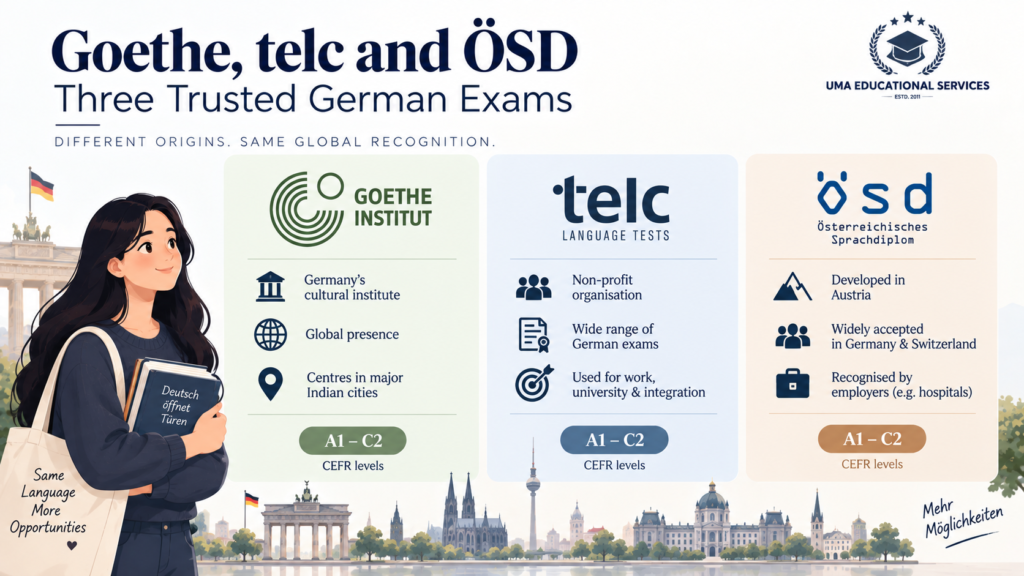
All three are established providers of German language exams, and all three map their certificates to the CEFR levels from A1 to C2. The differences lie in who runs them, how they are structured and where they are offered.
Goethe-Institut
The Goethe-Institut is Germany’s cultural institute, funded in part by the German government, and it runs exams worldwide. In India, it operates as the Max Mueller Bhavan, with exam centres listed on the Goethe-Institut India exams page across Mumbai, Pune, Delhi, Bengaluru, Chennai and Kolkata, plus a network of partner Goethe-Zentren.
telc
telc stands for The European Language Certificates. It is a non-profit subsidiary of the German Adult Education Association, and it runs a wide range of German exams for general, workplace, university and integration purposes. telc also designs the Deutsch-Test für Zuwanderer, the exam used in Germany’s integration courses.
ÖSD
ÖSD is the Austrian German language diploma, developed in Austria but used widely in Germany and Switzerland as well. The ÖSD itself notes that its certificates are accepted by employers in Germany, and that many hospitals and nursing homes accept its B2 certificate as proof of sufficient German.
How do Goethe, telc and ÖSD compare side by side?
The three exams test the same four skills, and the pass standard at each level is broadly equal. The practical differences are in format, booking and availability.
| Feature | Goethe | telc | ÖSD |
| Run by | Goethe-Institut (Germany) | telc gGmbH (Germany) | ÖSD (Austria) |
| Levels offered | A1 to C2 | A1 to C2, plus job and university versions | A1 to C2 |
| Skills tested | Reading, listening, writing, speaking | Reading, listening, writing, speaking | Reading, listening, writing, speaking |
| Modular from B1 | Yes, modules can be taken separately | Written and oral parts, rules vary by exam | Written and oral modules |
| Centres in India | Widest network | Licensed centres in several cities | Few centres |
| Specialist versions | Mostly general German | Nursing, medicine, university (C1 Hochschule) | Some profession-focused tests |
| Best known for | Universal recognition | Integration, work and profession-specific exams | Austria, and acceptance by German employers |
What “modular” means for you
Goethe exams from B1 upward are modular, which means you can take reading, listening, writing and speaking separately and retake only the module you failed. This is useful for Indian learners, who often pass the written modules first and need a second attempt at speaking.
Result timelines
All three providers usually issue results within a few weeks. The exact wait depends on the centre, so if you are working against a university or embassy deadline, ask the centre for its current turnaround before you book.
Which certificate works for a German student visa and university admission?
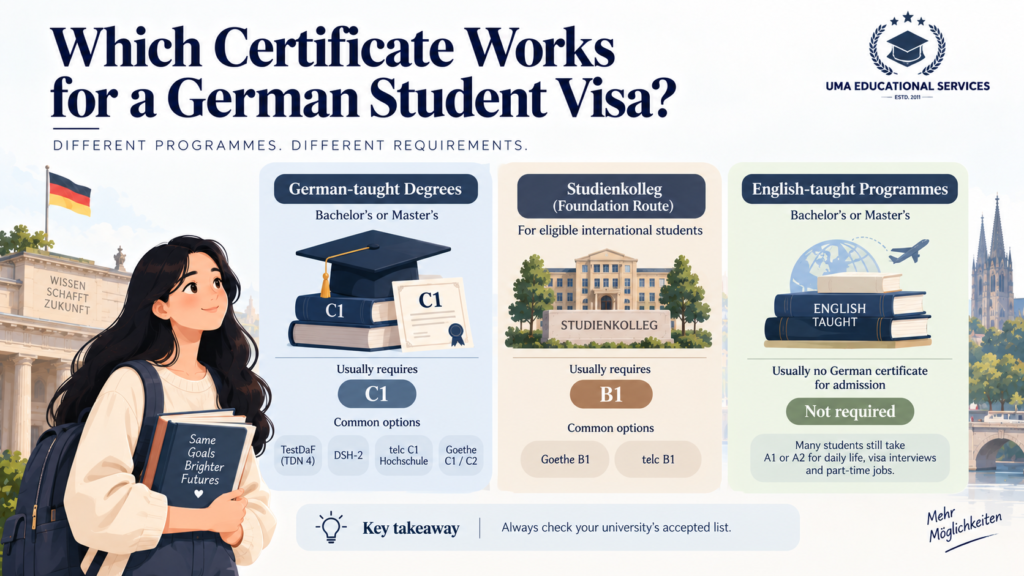
This is where the most confusion sits, because university admission and the student visa ask two different questions.
German-taught degrees
A German-taught Bachelor’s or Master’s usually asks for C1 German. The most common proofs are the TestDaF at TDN 4 in all sections, the DSH-2, the telc Deutsch C1 Hochschule and the Goethe C1 or C2 certificate. Each university publishes its own accepted list, and not every university accepts every exam.
Studienkolleg and foundation routes
Students who need a Studienkolleg, the foundation year for applicants whose school qualification is not directly accepted, usually need B1 to enter the entrance test. A Goethe or telc B1 is the typical proof.
English-taught programmes
For an English-taught degree, you usually need no German certificate for admission. Many students still take A1 or A2 before travelling, because it helps with the visa interview, the city registration office and part-time job searches. A student comparing destinations through an abroad consultancy in Thane should ask whether the programme is German-taught or English-taught before planning any exam at all.
Which certificate works for work visas, Ausbildung and nursing?
Work-related routes are more flexible about the provider and stricter about the level.
Skilled worker and Opportunity Card routes
The Opportunity Card needs at least A1 German or B2 English, and awards extra points for A2, B1 and B2 German. Goethe, telc and ÖSD certificates are all widely used for this. Skilled worker visas usually depend on the employer’s requirement, which is often B1 or B2.
Ausbildung
Vocational training programmes usually ask for B1 and sometimes B2, especially in health and care. Most training companies accept any of the three providers. What matters to them is the level and whether you can actually hold a conversation at the interview.
Nursing recognition
Nurses need B2, and some federal states ask for a nursing-specific exam such as telc Deutsch B1-B2 Pflege. Others accept a general B2 from Goethe, telc or ÖSD. Always check the rule with the authority handling your recognition file, because this is the route where the wrong certificate most often costs time.
| Purpose | Level | Goethe | telc | ÖSD |
| German-taught degree | C1 | Accepted by most universities | C1 Hochschule widely accepted | Accepted by many universities |
| Studienkolleg | B1 | Accepted | Accepted | Usually accepted |
| Opportunity Card | A1 minimum | Accepted | Accepted | Accepted |
| Ausbildung | B1 or B2 | Accepted | Accepted | Usually accepted |
| Nursing recognition | B2 | Often accepted | Pflege version preferred in some states | Accepted by many employers, check the state |
Which certificate works for a spouse visa or German citizenship?
Family and residence routes have the most standardised rules, and the choice between providers matters least here.
Spouse and family reunion visa
The spouse visa usually needs A1, and the Goethe Start Deutsch 1 is the certificate most Indian applicants submit because the German missions in India see it constantly. telc Deutsch A1 and ÖSD A1 are also used. Whichever you choose, the embassy wants an official certificate, not a course completion letter.
Settlement permit and citizenship
Permanent residence and citizenship usually require B1. In Germany, many applicants take the Deutsch-Test für Zuwanderer at the end of an integration course, while others submit a Goethe or telc B1. This decision normally happens after you have already moved, so it rarely affects your choice in India.
What does each certificate cost in time?
Fees change regularly and differ by city, so the more useful comparison is time: time to find a seat, time to sit the exam and time to receive the result.
Seat availability
Goethe exams in large Indian cities are popular, and seats often fill soon after registration opens. Learners who wait until they feel ready sometimes lose a month or two waiting for the next session. telc and ÖSD centres are fewer, but their sessions can be less crowded, so it is worth checking dates at both before your course ends.
Retakes
A modular exam saves time on a retake, because you repeat only the failed module. That matters most at B1 and B2, where speaking is the module learners most often fail. Check whether the exam you are booking lets you retake one part separately.
Preparation materials
Each provider publishes free model tests. Practising with the model test for your specific provider is more useful than general practice, because the task types differ slightly between them.
| Time factor | Goethe | telc | ÖSD |
| Finding a seat in India | Wide network, busy sessions | Fewer centres, often easier dates | Fewest centres |
| Retaking a failed part | Single module from B1 upward | Depends on the exam | Oral and written modules |
| Free model tests | Yes | Yes | Yes |
| Familiarity to Indian embassies | Highest | High | Lower, but valid |
How should you decide which German certificate to take?
The decision takes less time than most learners spend worrying about it, once you follow a simple order.
Step one: read the requirement
Go to the page that will judge your application and read the language line exactly. If it names one provider, book that one. If it names a level only, you have a free choice.
Step two: check the dates
Look at the next available exam date for each accepted provider in your city or a nearby one. The earlier date usually wins, because a certificate in hand is worth more than a slightly better-known one three months later.
Step three: prepare for the format
Once you have booked, switch your practice to that provider’s model tests. The level is the same across providers, but the task types and timings are not, and knowing the format is worth several marks.
Where the right advice helps
A good abroad consultant in Thane should be able to tell you which certificate your target university, employer or authority accepts before you enrol in an exam batch. That single check prevents the most expensive mistake in German preparation, which is passing the wrong exam.
Wrapping up
Goethe, telc and ÖSD all certify the same CEFR levels, and all three are respected. Goethe is the safest default for Indian applicants because every German authority recognises it and India has the widest network of centres. telc is equally strong for work, integration and university purposes, and has profession-specific versions. ÖSD is valid and accepted by many employers, though less common in India. Let the document that will judge your application make the choice, then book the earliest date.
UMAES prepares learners for the certificate their application actually names, with mock tests in that provider’s format rather than a generic practice paper. If you are unsure which exam to target, the German language course team can check the requirement with you before you book.
FAQs
Is the Goethe certificate better than telc?
No, neither is better in level. Both certify the same CEFR standard. Goethe is more familiar to Indian embassies and has more centres in India, while telc offers profession-specific exams such as nursing and a university C1 exam.
Is the ÖSD certificate accepted in Germany?
Yes, ÖSD certificates are accepted by many German employers, hospitals and universities. Acceptance is decided by each institution or authority, so always confirm that your specific university, employer or recognition office lists ÖSD before booking.
Which German certificate is needed for a spouse visa?
An A1 certificate is usually required, and the Goethe Start Deutsch 1 is the most common choice in India. telc and ÖSD A1 certificates are also used. The embassy needs an official exam certificate, not a course letter.
Does a Goethe German certificate expire?
No, Goethe certificates do not expire. However, some universities, employers and authorities prefer a recent certificate, often from the last one or two years, so check the specific requirement if your exam was taken some time ago.
Can I retake only one module of the Goethe exam?
Yes, from B1 upward Goethe exams are modular. You can retake only the module you failed, such as speaking, and combine the module certificates. This saves time and fees compared with repeating the entire exam.
Which exam do German universities accept for C1?
Most accept TestDaF at TDN 4, DSH-2, telc Deutsch C1 Hochschule and Goethe C1 or C2. Each university publishes its own list, so check the admissions page of every university you apply to.