
Summary
Switzerland offers high-quality education, strong international exposure, and respected universities. The main drawback is cost. Tuition is moderate, but living expenses are high. Indian students also face tighter work rules than many other study destinations. For an MS in Switzerland for Indian students, planning must cover finances, visa documents, and work eligibility.
Introduction
There are more than 4,000 study programmes in Swiss higher education. That gives Indian students real choice, especially for an MS in Switzerland for Indian students.
Still, many families worry about cost and post-study value. That concern is valid. Tuition may be manageable, but Switzerland’s living costs and work rules can change the final budget quickly.
This guide explains the real pros and cons in plain language. You will see where Switzerland shines, where it gets expensive, and who should seriously consider it.
What are the biggest advantages of studying in Switzerland?
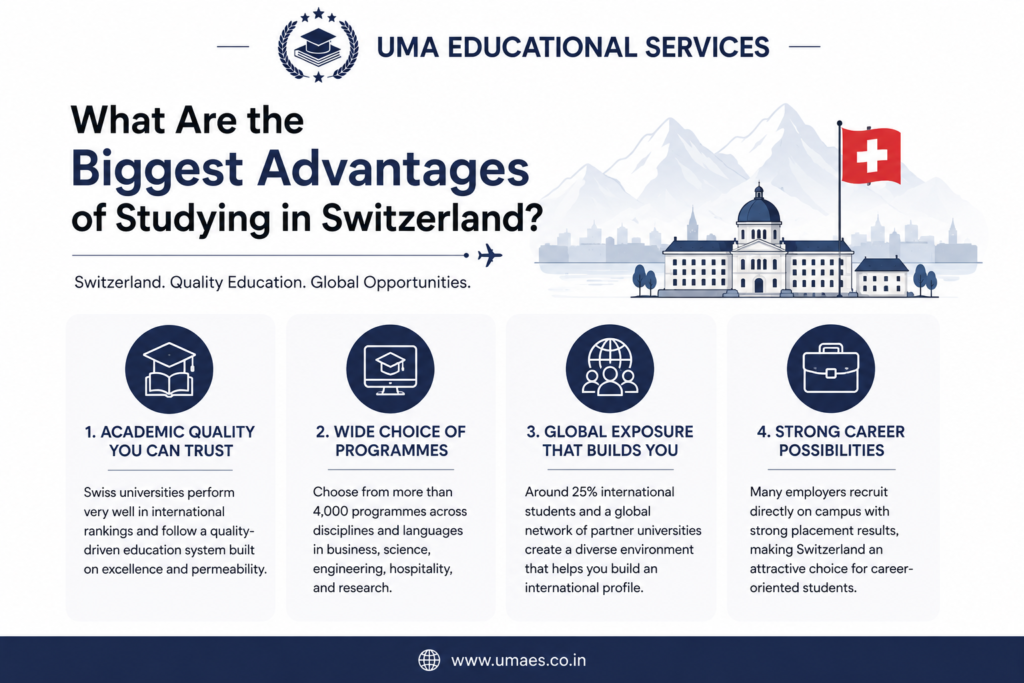
Switzerland is known for academic quality and strong higher education standards. The Swiss government says its universities usually perform very well in international rankings, and the education system is built around quality and permeability.
One major advantage is choice. There are more than 4,000 programmes across disciplines and languages. That helps students find a fit in business, science, engineering, hospitality, and research.
International exposure is another strong point. It has around 25% international students and a wide global network of partner universities. That kind of environment helps students build an international profile.
For career-oriented students, the Swiss market can be attractive. Many employers recruit directly on campus, and it highlights strong placement results. That does not guarantee a job, but it shows why Switzerland draws serious candidates.
What are the main disadvantages of studying in Switzerland?
The biggest con is cost. Tuition often falls between CHF 500 and CHF 2,000 per semester, but the costs of living are high. Monthly budgets can quickly become the real pressure point.
Another drawback is limited funding. Only a few bachelor’s and master’s students hold scholarships or grants. That means many students must rely on family support or part-time work.
Work flexibility is also narrower for non-EU/EFTA students. Foreign students may work a maximum of 15 hours per week during term time, and students from outside the EU/EFTA region may only start after six months.
| Pros | Cons |
| High academic quality and strong rankings. | High living costs. |
| Many programmes and languages. | Scholarships are limited at master’s level. |
| International student environment. | Part-time work rules are stricter for Indian students. |
| Strong employer visibility in some universities. | Visa and financial proof are non-negotiable. |
How much does an MS in Switzerland cost?
The full cost is not just tuition. Swiss universities usually ask for proof of sufficient funds, health insurance, and proof of admission before residence or visa processing.
A estimated student budget is around CHF 1,850 a month, depending on location and personal needs. Accommodation and food make up a large share of that figure.
| Expense | Typical range or estimate |
| Tuition | CHF 500 to CHF 2,000 per semester. |
| Living costs | Around CHF 1,850 per month in many cases. |
| Visa and residence proof | Financial resources and health insurance required. |
| Scholarships | Limited for many master’s students. |
A realistic plan should include rent, groceries, transport, insurance, and emergency savings. Switzerland can be worth it, but only when the budget is honest from the beginning.
Can Indian students work while studying in Switzerland?
Yes, but with limits. Foreign students may work up to 15 hours per week during studies and full-time during semester breaks. Employment must be reported to immigration authorities.
For students from outside the EU/EFTA region, the first six months are important. They may only begin working after six months of study, and the employer must submit the request for work permission.
After graduation, third-country nationals from a Swiss higher education institution have a six-month period to look for a job matching their qualifications. That creates a narrow but useful window for career entry.
Who should consider Switzerland for an MS?
Switzerland is a strong fit for students who value quality over low cost. It suits those who can fund living expenses, want an international classroom, and prefer a highly structured academic environment.
It is especially attractive for students in research-heavy or professionally focused paths. The strong university networks and employer connections can help students who want international exposure and disciplined career building.
It may not suit students who need a heavy part-time income to survive. The work rules and high monthly costs can make the experience stressful without proper funding.
How can UMAES help you plan your Switzerland application?
UMA Educational Services supports overseas education planning from Thane. Their site highlights admissions support, counselling, test preparation, and visa guidance for students looking at study abroad options.
That matters for Switzerland because the process needs careful budgeting and document planning. A good consultant helps with university shortlisting, funding clarity, visa readiness, and realistic course choices.
For an MS in Switzerland for Indian students, the right strategy is simple. Choose the course first, then test the budget, then check visa and work rules. UMAES can help you compare those steps before you apply.
FAQ
Is studying in Switzerland worth it for Indian students?
Yes, if you can handle living costs and want a high-quality education. Switzerland offers strong universities and international exposure, but it is not a low-cost destination.
Is an MS in Switzerland expensive?
Tuition is often moderate, but the total cost becomes high because of living expenses. Many students need around CHF 1,850 a month, plus tuition and insurance.
Can Indian students work part-time in Switzerland?
Yes, but with restrictions. Non-EU/EFTA students can work up to 15 hours per week during studies, and only after six months. During breaks, full-time work may be allowed.
Do Swiss universities offer many scholarships for master’s students?
Scholarships exist, but they are limited for bachelor’s and master’s students. Most students rely on personal funding or part-time income.
Conclusion
Switzerland offers strong academics, global exposure, and respected universities. It is a serious option for ambitious Indian students who want quality and international value.
The trade-off is cost and stricter work rules. If your funding is stable and your goals are clear, the return can be excellent. For a smarter plan, Talk to Experts at UMA Educational Services.