
By the UMAES Team | 10 min read
Each German level unlocks a specific door. A1 meets the spouse visa rule, A2 gets you through daily errands, B1 covers most Ausbildung and settlement requirements, B2 is what nurses and most employers want, and C1 is the usual bar for a German-taught degree. Picking a German language course in Thane starts with knowing which of these doors you need to open.
Key insights
- Levels are outcomes, not syllabus chapters: each one describes what you can do with the language in a real situation.
- Your purpose sets your target level: a spouse visa, an Ausbildung seat and a nursing licence each ask for something different.
- B1 is where German becomes useful on its own: below it, you still depend on someone else in any unplanned conversation.
- C1 is a university requirement, not a life requirement: most people who move to Germany for work never need it.
Before you go
Write down the one document that will ask for your German certificate, whether that is a visa form, a university portal or a hospital’s job advert. Read the exact level it names. That line decides your course plan, and everything else is detail.
Most people who ask about German classes ask the wrong first question. They want to know how long the course is, or what the fee is, when the real question is what they need German to do for them. A student applying to a Munich university, a nurse applying through the recognition route and a spouse joining a partner in Berlin all sign up for “German”, but they are aiming at three different finish lines.
This guide walks through the ladder level by level. It covers what each level lets you do in plain terms, which visas, universities and employers ask for which level, where learners usually stall, and how to set a realistic target before you pay for a single class.
What do the German levels A1 to C1 actually mean?
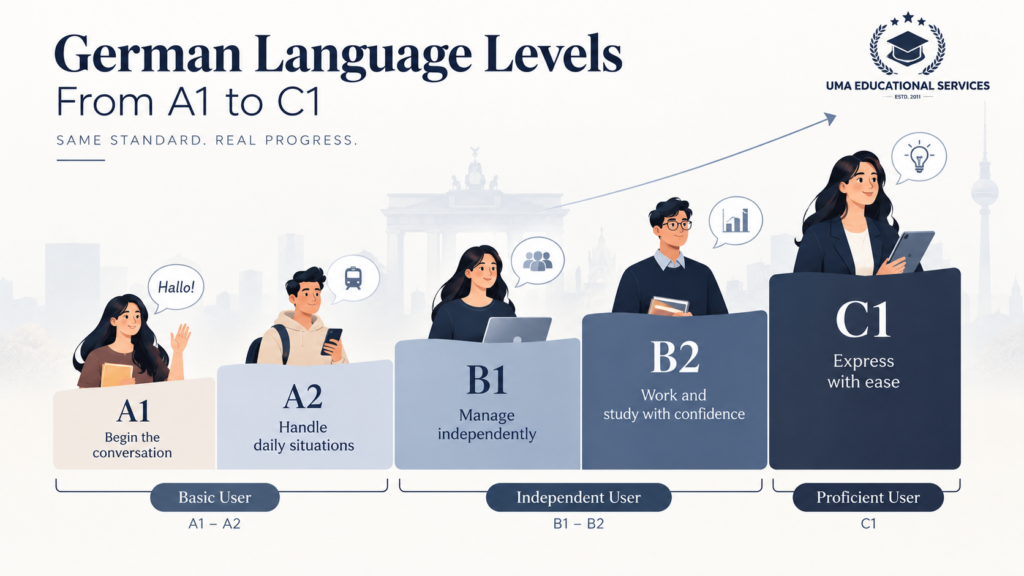
The levels come from the Common European Framework of Reference for Languages, usually shortened to CEFR. It was built by the Council of Europe to describe language ability in the same way across every European language, so a B1 in German means the same thing as a B1 in French or Spanish.
Six levels, three bands
The Council of Europe groups the six CEFR levels into three bands: the basic user at A1 and A2, the independent user at B1 and B2, and the proficient user at C1 and C2. That middle band is the one that matters most for anyone planning to live in Germany, because “independent” is literally the point at which you stop needing help.
Why the levels are written as “can do” statements
Every level is described through what a learner can do rather than what grammar they have covered. A1 is not “knows the present tense”. It is “can introduce themselves and ask simple questions about where someone lives”. That framing is useful for you, because it means you can test yourself against real situations instead of against a textbook.
The same scale works across languages
Because the framework is language-neutral, it also governs Spanish, French and every other European language you might study. Anyone weighing study in Spain for Indian students will meet the same A1 to C2 labels on Spanish-taught programmes, which usually ask for B1 or B2 Spanish. Once you understand the German ladder, you understand all of them.
What can you do at A1 and A2?
A1 and A2 are the survival levels. They let you handle predictable, everyday situations where the other person is patient and the vocabulary is familiar.
A1: introductions and simple transactions
At A1 you can introduce yourself, give your address and phone number, order food, buy a ticket and understand very slow, clear speech about everyday things. You cannot yet follow a conversation between two native speakers, and a phone call with a landlord will lose you in the first minute.
A1 is also the level named in the spouse visa rule. Germany’s Residence Act asks joining spouses to show basic German at A1 in most cases, and the Goethe-Institut’s Start Deutsch 1 is the certificate most applicants submit.
A2: routine life, with effort
At A2 you can describe your job, your family and your daily routine, and you can manage errands such as a pharmacy visit or a bank appointment. You understand the main point of short, clear announcements and messages.
The gap between A1 and A2 is mostly vocabulary and past tense. Learners at A2 often feel confident in class and then freeze in a German supermarket, because real speech is faster and less tidy than a coursebook recording.
What A1 and A2 will not do for you
Neither level is enough for a job interview, a university lecture or a patient conversation. Treat them as foundations rather than finish lines, unless your only goal is a spouse visa or a basic Opportunity Card application.
| Level | Real situation you can handle | Real situation that still defeats you | Who usually needs it |
| A1 | Ordering food, buying a ticket, filling a simple form | Any phone call, any unplanned question | Spouse visa applicants |
| A2 | Doctor’s appointment, describing your job | Workplace small talk at normal speed | Early Ausbildung applicants, Opportunity Card points |
What changes at B1 and B2?
B1 and B2 are the independent levels, and they are where German starts working for you rather than the other way round.
B1: the threshold of independence
At B1 you can deal with most situations that come up while travelling or living in a German-speaking country. You can tell a story, explain a plan, give reasons for an opinion and write a simple personal letter or email.
B1 is the level most often written into official German rules. Many Ausbildung programmes ask for it, it earns points on the Opportunity Card, and it is the standard requirement for a permanent settlement permit and for citizenship. For a large share of people who move for work, B1 is the most important certificate they will ever hold.
B2: professional German
At B2 you can follow the main ideas of complex speech, including technical discussion in your own field, and you can talk with native speakers fluently enough that neither side is straining. You can write clear, detailed texts and argue a point of view with pros and cons.
This is the level employers mean when they ask for “good German”. It is also the level nurses need for professional recognition in Germany, which is why nursing candidates spend most of their preparation time between B1 and B2.
The jump between B1 and B2 is the longest
Most learners are surprised by how long B1 to B2 takes. The grammar is largely in place by B1, so the extra months go into vocabulary range, listening speed and the ability to speak without rehearsing first. Those are skills that come from exposure, and exposure cannot be rushed.
| Level | What you can do at work | What you can do in daily life | Common official use |
| B1 | Handle routine tasks with colleagues, write simple emails | Manage almost any errand, follow the local news slowly | Ausbildung, settlement permit, citizenship |
| B2 | Join meetings, explain technical points, handle a patient or client | Hold natural conversations, follow films without subtitles | Nursing recognition, most skilled jobs |
What is C1 for, and who needs it?
C1 is the proficient level. At C1 you can understand long, demanding texts, recognise implied meaning, and use German flexibly for academic and professional purposes without searching for words.
C1 is mostly a university requirement
Most German-taught degree programmes ask for C1 in practice, usually through the TestDaF with a score of TDN 4 or the DSH-2 exam. The DAAD notes that the DSH has to be taken in Germany, while the TestDaF is offered in around 100 countries, which is why most Indian applicants sit the TestDaF from home.
When you can skip C1 entirely
If you are applying to an English-taught Master’s programme, you usually do not need German for admission at all. You will still want A2 or B1 for daily life and part-time work, but C1 is not on your path. The same is true for most skilled workers, whose employers want B1 or B2 and rarely ask for more.
What C1 feels like in practice
At C1 you stop translating in your head. You can follow a lecture, take notes in German, write a structured seminar paper and disagree with a professor politely. It is a genuinely high level, and reaching it from zero usually takes well over a year of serious study.
Which German level does your purpose require?
The simplest way to set your target is to start from the document that will ask for your certificate. Germany’s official portal publishes a breakdown of the German skills each visa and residence type requires, and it is worth reading before you choose a course.
Matching purpose to level
| Your purpose | Level usually required | Certificate most often submitted | Notes |
| Spouse or family reunion visa | A1 | Start Deutsch 1 | Exemptions exist for some skilled-worker families |
| Opportunity Card | A1 German or B2 English minimum | Any recognised certificate | A2, B1 and B2 German each add points |
| Ausbildung | B1, sometimes B2 | Goethe or telc B1 | Health and care Ausbildung often asks for B2 |
| Nursing recognition | B2 | Goethe B2 or telc B1-B2 Pflege | Rules vary slightly by federal state |
| German-taught degree | C1 | TestDaF TDN 4 or DSH-2 | Studienkolleg entry usually needs B1 |
| English-taught Master’s | None for admission | Not applicable | A2 to B1 strongly advised for life and jobs |
| Settlement permit or citizenship | B1 | Goethe, telc or DTZ | Checked at the time of application |
When two purposes overlap
Many learners have a first goal and a second goal. A student on an English-taught course often wants to stay after graduating, which means B1 for a settlement permit a few years later. A nurse needs B2 now and may want C1 later for a senior role. Plan the course around the nearer goal, but pick certificates that will still count for the later one.
Where do learners usually stall on the ladder?

Every learner stalls somewhere, and the stall points are predictable enough to plan around.
The A2 plateau
The first stall comes at the end of A2. The coursebook grammar is familiar, but real conversation still feels impossible. Learners who push through this stage usually do it by adding listening practice outside class, not by repeating the same grammar drills.
The B1 speaking wall
The second stall is speaking at B1. Many Indian learners can read and write at B1 well before they can speak at B1, because school taught them to learn languages on paper. The fix is regular speaking practice with correction, not more homework.
The B2 vocabulary gap
The third stall is B2 vocabulary. B2 asks you to talk about abstract topics such as work, society and the environment, and to do it with precision. If your German has only ever covered daily life, the vocabulary for opinion and argument has to be built deliberately.
How should you choose a German course based on your target level?
Once you know your target, the course decision gets much simpler, because you are no longer comparing fees and timetables in the abstract.
Look for a course that names the exam
A good German course states which certificate it prepares you for and at which level. If a course only promises “German fluency”, it has not thought about your finish line. Ask which exam each level ends with, and whether mock tests are part of the course.
Check speaking time, not just teaching hours
Ask how many minutes each student actually speaks in a typical class. Large batches with a single teacher can cover the grammar but rarely produce confident speakers, and speaking is the part of every German exam that learners fail most often.
Match the pace to your life
A full-time student can manage an intensive batch. A working professional usually cannot, and a course designed for someone with no day job will leave them behind. The best German language classes in Thane offer both formats, so the level plan fits the life you actually have. You can compare the format options on the German language course page, which lists how the levels are sequenced.
| What to check | Why it matters | A good answer sounds like |
| Exam named for each level | Keeps the course tied to a certificate | “A1 ends with the Start Deutsch 1 mock” |
| Speaking time per class | Speaking is the most failed section | “Every student speaks in pairs each session” |
| Batch format | Pace has to fit your working day | “Weekday evening and weekend batches” |
| Progress checks | Stops you moving up before you are ready | “A level test before the next level starts” |
Wrapping up
German levels are easiest to understand as answers to one question: what do you need to be able to do? A1 gets a spouse visa, A2 gets you through errands, B1 carries you through most of daily and official life, B2 opens professional work and nursing, and C1 is for German-taught study. Choose the level your purpose demands, then choose a course that names that exam at the finish.
UMAES plans German training around that finish line rather than around a fixed course length, which is how learners heading to universities, hospitals and Ausbildung programmes end up with the certificate their application actually asks for. If you are unsure which level you need, the team at the language preparation centre can map your purpose to a level and a timeline before you enrol.
FAQs
Which German level do I need to study in Germany?
For a German-taught degree you usually need C1, shown through TestDaF TDN 4 or DSH-2. For an English-taught programme, no German is required for admission, although A2 or B1 makes daily life and part-time work far easier.
Is A1 German enough to live in Germany?
No, A1 is enough for a spouse visa but not for independent living. It covers introductions and simple transactions. Most people need B1 before they can handle landlords, offices and workplace conversations without help.
Which German level do nurses need for Germany?
Nurses usually need B2 for professional recognition in Germany. Some federal states accept B1 at entry during an adaptation period, but B2 is required before full recognition, so most candidates prepare for B2 from the start.
How is B1 different from B2 German?
B1 lets you manage everyday life and routine work independently. B2 adds the ability to discuss abstract and technical topics fluently, follow complex speech and argue a view clearly, which is why employers and nursing boards ask for it.
Do I need C1 German to work in Germany?
Usually not. Most employers ask for B1 or B2, depending on the role. C1 is mainly a university admission requirement, though it can help in senior, client-facing or academic positions where written German carries weight.
Are German levels the same for every exam?
Yes, Goethe, telc and ÖSD certificates all use the same CEFR levels from A1 to C2. The exam formats differ, but a B1 from any recognised provider describes the same ability and is accepted for most official purposes.